Creator · Composer
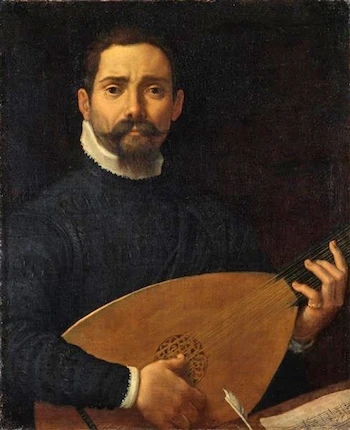
Giovanni Gabrieli
Biography
The genesis of the magnificent Baroque concert style, for which the great composers of the Romantic period and 20th century felt a deep piety (Brahms and Ravel among them), was rooted in the art of the old Venetian masters. Giovanni Gabrieli was a composer and organist, a pupil of his famous uncle Andrea Gabrieli, maestro of the music chapel in the magnificent Venetian cathedral of San Marco. Giovanni served for several years at the court of Albrecht V, Duke of Bavaria. There he studied with the famous Orlando di Lasso. After the Duke's death he returned to his native Venice and in 1585 became organist at San Marco. At the same time he held the same post at the "Scuola Grande di San Rocco", one of the most prestigious and wealthy Venetian religious fraternities. After Andrea Gabrieli's death, he was elevated to the position of chief composer of San Marco. He composed mainly sacred music, as well as instrumental works in the then popular genres of canzoni, sonatas and ricercari. Some of these were published in his first collection of 1597, Sacrae symphoniae, which became so famous throughout Europe that it attracted many composers to study with the Venetian master, such as Heinrich Schütz, Hans Leo Hassler, and Michael Praetorius. Giovanni Gabrieli's fame is due to the magnificent combination of simplicity and brilliance in his music. And his polyphonic technique is based on a taste for contrast, dialogue or opposition between groups of instruments, solo voices with instrumental accompaniment and choirs a cappella. A tradition that developed from the so-called Venetian antiphonal, polychoral style, derived from the unusual architecture of the Basilica of San Marco. It is built with two galleries for the choirs, facing each other, each with its own organ. Gabrieli masterfully uses this unusual church layout to create striking spatial echo-effects. Most of his pieces are written so that a choir or instrumental ensemble can be heard on one side, followed by a response from the musicians on the other side. Sometimes it includes a third group of musicians positioned near the central altar of the basilica. He wrote two scrolls of Sacrae symphoniae tam vocibus quam instrumentis ("Sacred Symphonies for Voices and Instruments"), in 1597 and 1612. The first collection includes 42 motets from 6 to 16 voices, 14 canzonas and 2 sonatas.
Works
Past events
Ludmil Angelov & Sascha Goetzel
Bulgaria Concert Hall
Choir Concert with Renaissance music
Bulgaria Concert Hall
Концерт (Музиката през вековете)
Зала "България"